

Automated Robotic Welding & Fine Manual Polishing
February 3, 2017
Raw Material Selection & Strict Incoming Inspection
February 3, 2017
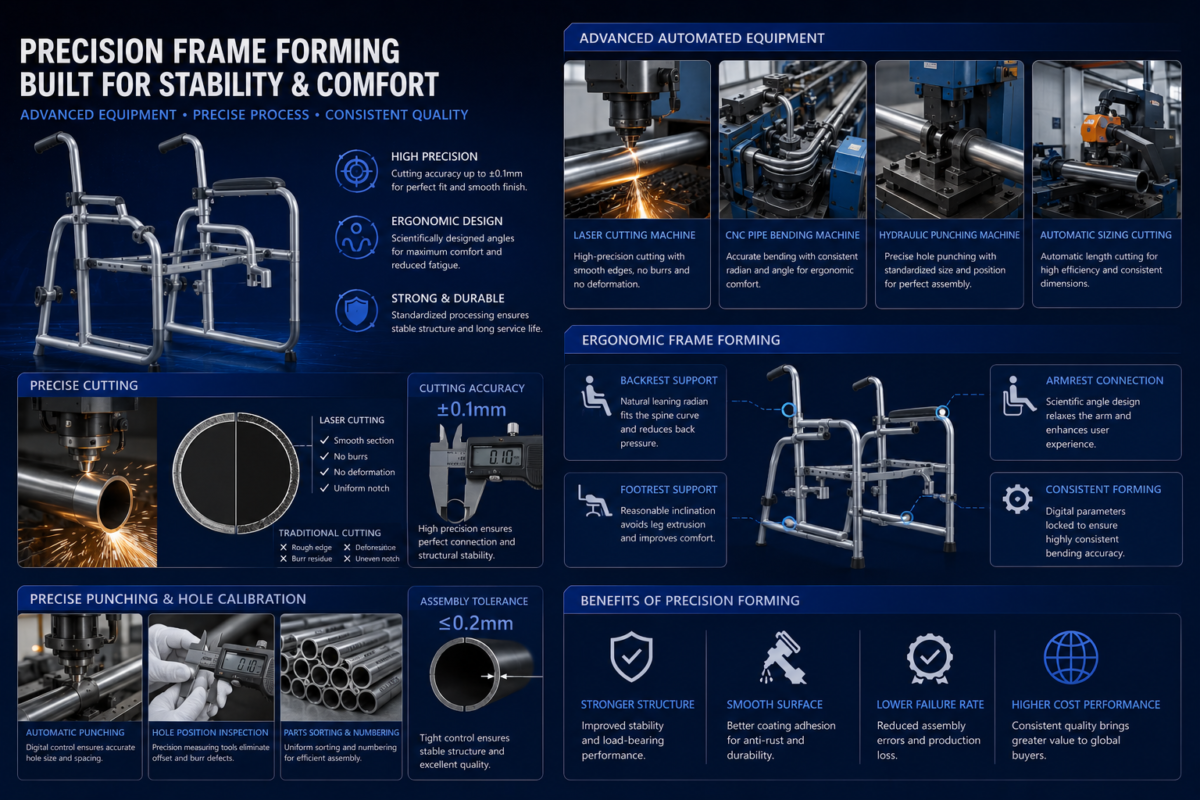
The wheelchair frame is the main supporting structure of the product, and its cutting accuracy and forming rationality directly determine the overall stability, appearance smoothness and user comfort of the wheelchair. In order to achieve industrial-grade precision production, our factory is equipped with a full set of advanced automated processing equipment, including multi-axis laser cutting machines, numerical control pipe bending machines, hydraulic punching machines and automatic sizing cutting equipment. We abandon the traditional manual cutting and semi-automatic mechanical cutting modes that have large errors and rough cuts, and fully adopt intelligent digital processing technology to realize high-precision cutting of metal pipes. The laser cutting equipment we use has a cutting accuracy of ±0.1mm, which can accurately cut metal pipes of different specifications and calibers. Compared with traditional cutting technology, laser cutting has the advantages of smooth cutting section, no burr residue, no metal deformation and uniform notch size, which greatly improves the flatness of the frame connecting parts.
In terms of frame forming, all bending and shaping processes are completed by professional numerical control pipe bending machines. We have established a complete ergonomic database based on human body data of different age groups, heights and weights around the world. The bending angle, radian and spacing of each frame pipe are strictly designed according to ergonomic principles. For example, the backrest support pipe adopts a natural leaning radian, which fits the human spine curve and reduces back pressure during long-term sitting; the armrest connecting pipe is bent at a scientific angle to ensure that the user’s arm is placed in a relaxed state; the footrest support pipe is reasonably inclined to avoid leg extrusion and friction. All bending parameters are digitally set and locked by the system, so that the bending radian and angle of each batch of wheelchair frames remain highly consistent, effectively solving the problem of inconsistent product appearance and structural deviation caused by manual operation errors.
In addition to cutting and bending, we also carry out precise punching and hole position calibration for the frame. The hydraulic punching machine automatically completes the punching operation according to the preset digital parameters, ensuring that the aperture size, hole spacing and hole position symmetry of the connecting holes are completely standardized. After punching, professional inspectors use precision measuring tools to check each hole position to eliminate offset and burr defects. All processed frame parts are sorted and numbered uniformly, and the assembly gap between parts is controlled within 0.2mm during subsequent assembly. The smooth and flat pipe surface after precision cutting and forming also provides excellent adhesion conditions for the later electrostatic spraying process, making the spray coating uniform and firm, effectively preventing the paint layer from falling off and rusting in the long-term use and transportation process. This standardized precision forming process not only improves the structural stability and aesthetic appearance of wheelchairs, but also reduces assembly failure rate and production loss, bringing higher cost performance and stable quality to global buyers.

